FREE MASTERCLASS - Discover the real reasons behind your child’s struggles and what to do next.

ADHD, AUTISM, ANXIETY AND CHILD DEVELOPMENT — EXPLAINED
Practical articles to help you understand your child’s behaviour and health.
STOP MANAGING SYMPTOMS.
START UNDERSTANDING YOUR CHILD.
Explore the Root Causes behind Attention, Behaviour and Learning Challenges.
Parent-Led. Science-Backed. Drug-Free.
BLOG

PANS and PANDAS Symptoms in Children | The Brain Health Movement
One day your child was fine. The next, they weren’t. The anxiety came from nowhere. The meltdowns. The tics. The refusal to eat. The overnight personality shift that left you thinking, "What happened to my child?"
If this sounds like your family, please keep reading. Because what you’re seeing might not be a behavioural problem, a parenting issue, or a mental health condition at all. It could be something called PANS or PANDAS. And understanding that changes everything.
PANS and PANDAS: The Conditions No One Told You About
PANS (Paediatric Acute-onset Neuropsychiatric Syndrome) and PANDAS (Paediatric Autoimmune Neuropsychiatric Disorder Associated with Streptococcal Infection) are autoimmune conditions that cause sudden, dramatic neuropsychiatric symptoms in children.
Here’s what happens. Your child picks up an infection, a strep throat, a virus, sometimes even just a cold. Their immune system kicks in to fight it. But instead of standing down once the infection clears, the immune system stays on high alert. It turns inward. It attacks a part of the brain called the basal ganglia, the region that controls movement, learning, emotions and decision-making.
The result? Brain inflammation. And that inflammation is what’s driving the sudden changes you’re seeing in your child.
PANDAS is specifically triggered by strep. PANS can be triggered by any number of infections or environmental factors. Both produce the same devastating picture. And research suggests they may affect as many as 1 in 200 children.
The Defining Feature: It Happens Overnight
This is the thing that sets PANS and PANDAS apart from everything else. The onset is sudden. Sometimes literally overnight. A child who was happy, settled and thriving can change within hours.
That’s the clue that so many healthcare providers miss. They see the anxiety and diagnose generalised anxiety disorder. They see the OCD and prescribe medication. They see the aggression and label it oppositional defiant disorder. But they don’t ask the question that matters most: when did this start?
If the answer is "suddenly", and especially if it followed an illness, that changes the picture entirely.
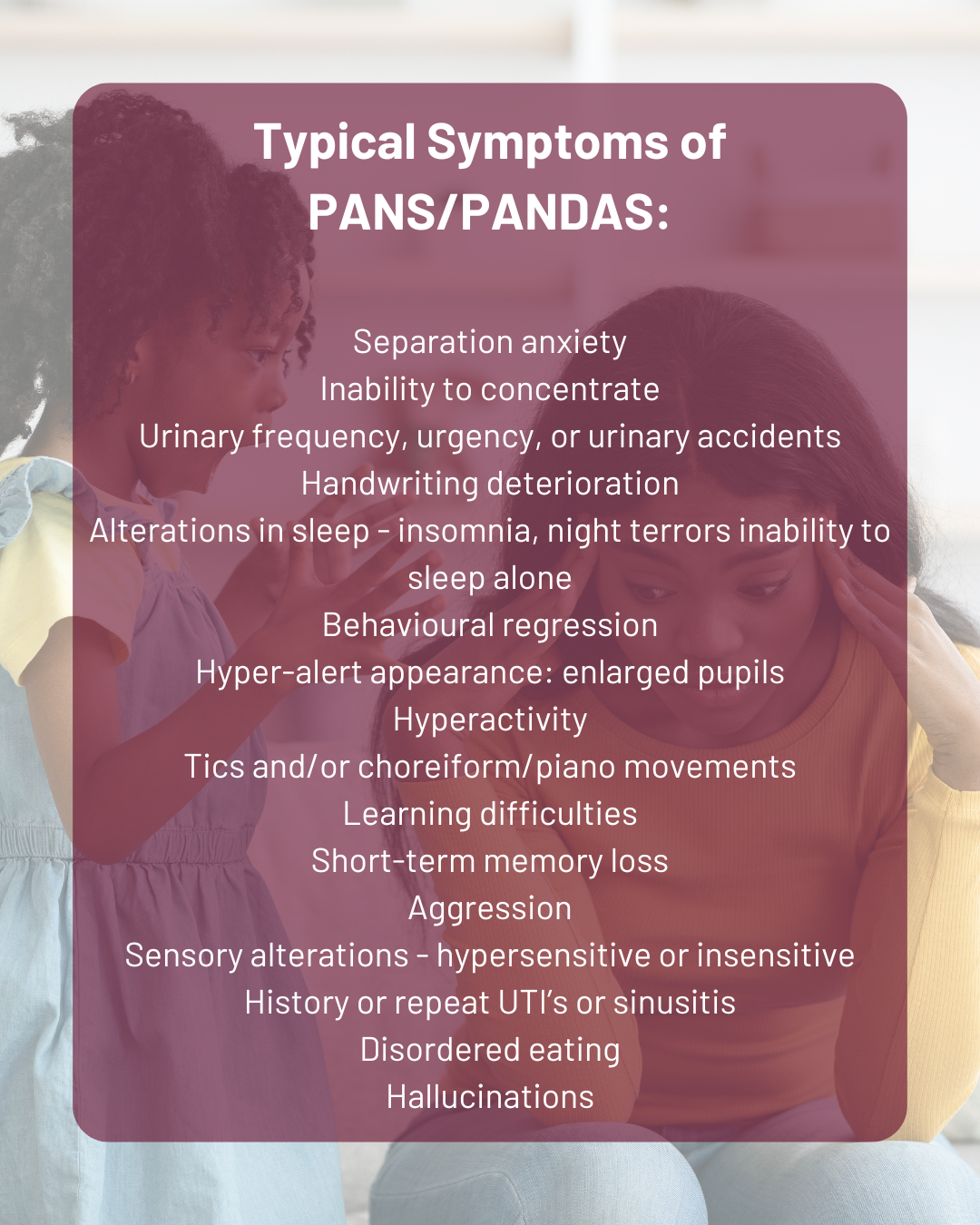
The Symptoms: What to Look For
The two most common symptoms are OCD (obsessive compulsive disorder) and severely restricted food intake. But the full picture is much broader. Here are the key signs:
OCD and Intrusive Thoughts
This might show up as mental OCD, compulsive, repetitive thoughts your child can’t shake, or as physical rituals and repetitive behaviours. In younger children, it can look like an intense, distressing need for everything to be done a certain way.
Restrictive Eating
Not ordinary fussiness. A sudden, dramatic refusal to eat. Some children will only accept one or two foods. Others stop eating almost entirely. This can become medically serious very quickly.
Severe Anxiety and Separation Anxiety
Separation anxiety is present in up to 98% of PANS/PANDAS cases. Your previously independent child may suddenly be unable to leave your side, terrified of school, or inconsolable when you leave the room.
Tics
Motor tics (eye blinking, head jerking, facial movements) and vocal tics (throat clearing, sniffing, sounds) appear in around 70% of cases. They often arrive alongside other symptoms and can be mistaken for Tourette’s syndrome.
Emotional and Behavioural Regression
Baby talk. Wanting to watch cartoons they outgrew years ago. Playing with baby toys. Bed-wetting. Aggression, refusal, and emotional outbursts that are completely out of character. It’s as though your child has gone backwards, and in a very real neurological sense, they have.
Academic and Cognitive Decline
Brain fog, concentration difficulties, and short-term memory loss are reported in up to 90% of cases. Handwriting deterioration (dysgraphia) is another telltale sign, present in around 90% of children with PANS/PANDAS. If your child’s school performance has dropped off a cliff, this could be why.
Sleep Problems
Insomnia, night terrors, inability to sleep alone. Sleep disturbances affect around 80% of children with PANS/PANDAS and make everything harder for the whole family.
Sensory Sensitivities and Urinary Changes
Sudden hypersensitivity to light, sound, textures, or clothing. Urinary frequency, urgency, and accidents (reported in up to 90% of cases). These are some of the lesser-known signs, but they can be important early indicators.
Why So Many Children Are Misdiagnosed
Because the symptoms overlap with ADHD, autism, anxiety, OCD, and Tourette’s, children with PANS and PANDAS are frequently given these labels instead. Many families spend months or even years pursuing the wrong diagnosis before someone finally connects the dots.
The key questions to ask are: Did this come on suddenly? Does it get worse after illness? Does it come and go in cycles? If the answer to any of these is yes, PANS or PANDAS deserves investigation.

What You Can Do Right Now
If you’re reading this and thinking, "This is my child," here’s where to start:
1.Download our free guide. We’ve created a comprehensive guide specifically for parents: the PANS/PANDAS Free Guide. It'lll walk you through what’s happening in your child’s brain and body, and what to do next. You can also learn more about PANS/PANDAS here.
2.Talk to your GP. Ask for a strep antibody test (ASO and Anti-DNase B). If your GP isn’t familiar with PANS/PANDAS, our guides contain information you can share with them.
3.Learn about treatment. There is a well-established three-pronged approach to treating PANS and PANDAS. Understanding it will help you have better, more informed conversations with your child’s care team.
4.Connect with other parents. You don’t have to figure this out alone. Our Facebook community is full of parents who’ve been exactly where you are.
This Is Not Your Fault
Let’s be clear about something. PANS and PANDAS are autoimmune conditions. They are not caused by something you did or didn’t do as a parent. The overnight changes you’ve witnessed are real, they are medical, and they are treatable.
At The Brain Health Movement, we exist because Lucia went through this with her own son, Quinn. She knows what it’s like to watch your child change overnight and feel completely powerless. And she built this community so that no parent has to navigate that journey without support.
Our Whole Child Healing Roadmap course includes a dedicated PANS/PANDAS and autoimmunity module with Dr Nancy O’Hara, one of the world’s leading experts in the field. But the course goes far beyond that single module. Every practitioner and doctor in the course is experienced in working with children with PANS/PANDAS.
Their approaches to nervous system regulation, gut and immune health, retained reflexes, inflammation, detoxification, nutrition and neurodevelopment are all directly relevant and supportive for families navigating these conditions.
And if you’re just beginning to understand what’s really going on, our free masterclass is a powerful first step.
Your instincts brought you here. Trust them.
Stop chasing symptoms.
Start healing the root cause.
FREE MASTERCLASS
"From Burnout to Breakthrough"
Your child doesn’t need more labels.
You need more answers.
Discover the real reasons behind your child’s struggles - and why your nervous system holds the key to your child’s ability to heal.
Need More Support?
If you're feeling overwhelmed and just need to be heard and supported to work out the best next step, then book a 1:1 Parent Support session with Lucia.