BACK-TO-SCHOOL SUPPORT
Is your child struggling with school? Find practical tools, expert guidance and a clearer place to start.

ADHD, AUTISM, ANXIETY AND CHILD DEVELOPMENT — EXPLAINED
Practical articles to help you understand your child’s behaviour and health.
STOP MANAGING SYMPTOMS.
START UNDERSTANDING YOUR CHILD.
Explore the Root Causes behind Attention, Behaviour and Learning Challenges.
Parent-Led. Science-Backed. Drug-Free.
BLOG

PANS PANDAS Treatment: The Three-Pronged Approach | BHM
Your child has been diagnosed with PANS or PANDAS, or you strongly suspect it’s what’s behind their sudden changes. The relief of having a name for it is real. But so is the next question that hits you:
"What do we do now?"
The good news? PANS and PANDAS are treatable. Children do get better. And understanding the approach that leading experts use will help you feel more confident, more informed, and more in control.
First, Understand What’s Happening
In PANS and PANDAS, the body’s immune system has gone rogue. Instead of just fighting the infection, it’s turned on the brain. Specifically, it’s attacking the basal ganglia, the brain’s information highway for movement, emotions, learning and decision-making.
That’s why the symptoms are so wide-ranging and so sudden. The OCD, the tics, the anxiety, the emotional dysregulation, the academic decline: it’s all coming from the same place. Brain inflammation.
So effective treatment needs to tackle three things: the infection, the inflammation, and the symptoms.
The Three-Pronged Approach
This is the framework used by leading PANS/PANDAS experts, including Dr Lindsey Wells, Dr Nancy O’Hara, and Dr Lauren Lee Stone. It’s not a one-size-fits-all prescription. It’s a structure that your child’s care team can adapt to their specific needs.
Prong 1: Antimicrobial Support
Step one is dealing with the infection that triggered the immune response in the first place. In PANDAS cases, that’s strep. In PANS, it could be viral, bacterial, or fungal.
This might mean antibiotics prescribed by your doctor, or antimicrobial herbals for families exploring natural options. The goal is simple: clear the infection so the immune system can start to stand down.
Prong 2: Reducing Inflammation
This is the big one. If brain inflammation is driving the symptoms, then reducing that inflammation is critical.
Medical options include anti-inflammatory medications and, in more severe cases, immunomodulatory therapies. But there are also accessible, natural approaches that many families find helpful: probiotics and prebiotics to support gut health and immune function, omega-3 fatty acids (EPA/DHA) for their anti-inflammatory properties, curcumin, and flavonoids such as quercetin.
One simple first step suggested by Dr Lindsey Wells: try a week of ibuprofen. If you notice a significant improvement in symptoms, that’s a strong signal that inflammation is playing a role, and it’s worth investigating PANS/PANDAS further.
Important: Always speak with a medical professional before starting any new treatment for your child.
Prong 3: Symptom Support
While you’re tackling the root cause, your child still needs support with what they’re experiencing day to day. This might include CBT (cognitive behavioural therapy) for OCD and anxiety, occupational therapy for sensory and motor difficulties, and practical strategies for sleep, eating, and emotional regulation.
And here’s something many parents don’t realise: your own nervous system plays a huge role. When you are regulated, your child is better able to co-regulate. This isn’t about being perfect. It’s about understanding that your calm is one of the most powerful tools in your child’s recovery.
We have a free webinar which covers nervous system regulation, you can watch it here.

Natural Support Strategies
Many families combine conventional treatment with natural and complementary approaches. Some of the most commonly discussed options among PANS/PANDAS specialists include:
•Magnesium for tics, sleep and anxiety
•N-Acetyl Cysteine (NAC) for OCD support
•Probiotics (Lactobacillus, Bifidobacterium, Saccharomyces Boulardii) for immune and gut health
•Essential fatty acids for reducing inflammation
•Passionflower and L-Theanine for calming repetitive thoughts
•Dietary adjustments to lower the inflammatory load
Our free PANS/PANDAS guide goes into much more detail on these options, including the research behind them.
Every Child Is Different
There’s no single protocol that works for every child. PANS and PANDAS present differently in every family, and treatment needs to be tailored. What helps one child may not help another. What matters is that you’re working with practitioners who understand the condition and are willing to take your concerns seriously.
If you’re finding it difficult to get the right support, you’re not alone. Many parents face this. Our PANS/PANDAS parent support resources can help you navigate the system and connect with families who’ve walked this path.

Go Deeper
We’ve produced two powerful podcast episodes on PANS and PANDAS. In Season 2, Episode 4, Dr Lindsey Wells unpacks the mystery behind sudden psychiatric changes. And in Season 2, Episode 8, Dr Nancy O’Hara explores the question every parent asks: is it behaviour, or is it brain inflammation?
For the full picture, our Whole Child Healing Roadmap course includes a dedicated autoimmunity module with Dr Nancy O’Hara. But what makes the course especially powerful for PANS/PANDAS families is that it doesn’t stop there. Every expert in the course brings knowledge that directly supports children with these conditions, from nervous system regulation and gut health through to inflammation, detoxification, retained reflexes and neurodevelopment. It’s a complete, multi-disciplinary approach, which is exactly what PANS/PANDAS demands.
Your child’s brain is not broken. It’s inflamed. And inflammation can be treated.
Stop chasing symptoms.
Start healing the root cause.
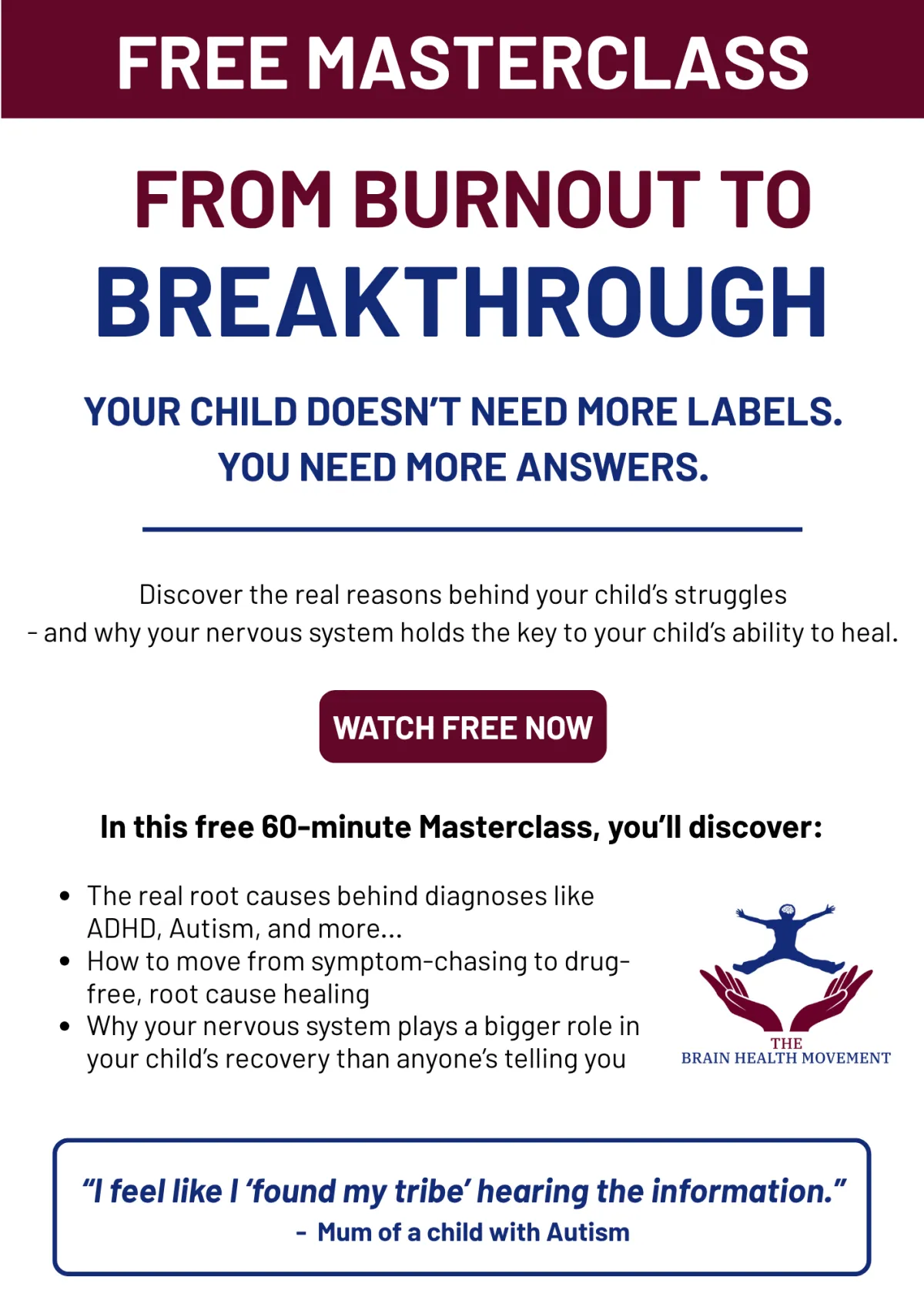
FREE MASTERCLASS
"From Burnout to Breakthrough"
Your child doesn’t need more labels.
You need more answers.
Discover the real reasons behind your child’s struggles - and why your nervous system holds the key to your child’s ability to heal.
Need More Support?
If you're feeling overwhelmed and just need to be heard and supported to work out the best next step, then book a 1:1 Parent Support session with Lucia.