
BACK-TO-SCHOOL SUPPORT FOR THE WHOLE CHILD
BACK-TO-SCHOOL SUPPORT
FOR THE WHOLE CHILD
School Struggles?
Start Here!
School may be where your child’s struggle becomes visible. It is not always where the struggle begins.
Anxiety. Meltdowns. Exhaustion. Poor concentration. Sensory overwhelm. Reading or handwriting difficulties. Morning distress. School avoidance.
These struggles may look separate.
But they could be connected.

School Struggles? Start Here! will help you understand the clues, recognise important patterns and choose one informed, manageable change that could make everyday life feel easier for your child and your family.
Instant digital access. Download, print and begin whenever you are ready.
Free guides explain one topic. This is a complete system for your child.

UNDERSTAND
Look beyond the visible behaviour and understand how regulation, development, sleep, cellular energy, nutrition, sensory processing, movement, vision, environment and school demands may influence your child’s capacity.

RECOGNISE
Use the Whole Child Snapshot and Seven-Day School-Day Tracker to identify repeated symptoms, difficult times, hidden demands and the support that genuinely helps.

ACT
Choose one realistic first shift, create a simple 30-day action plan and gather clearer information to support conversations with your child, school and professional team.
What's Inside?
More than an ebook.
A practical place to begin, with everything you need included.
Start Today!
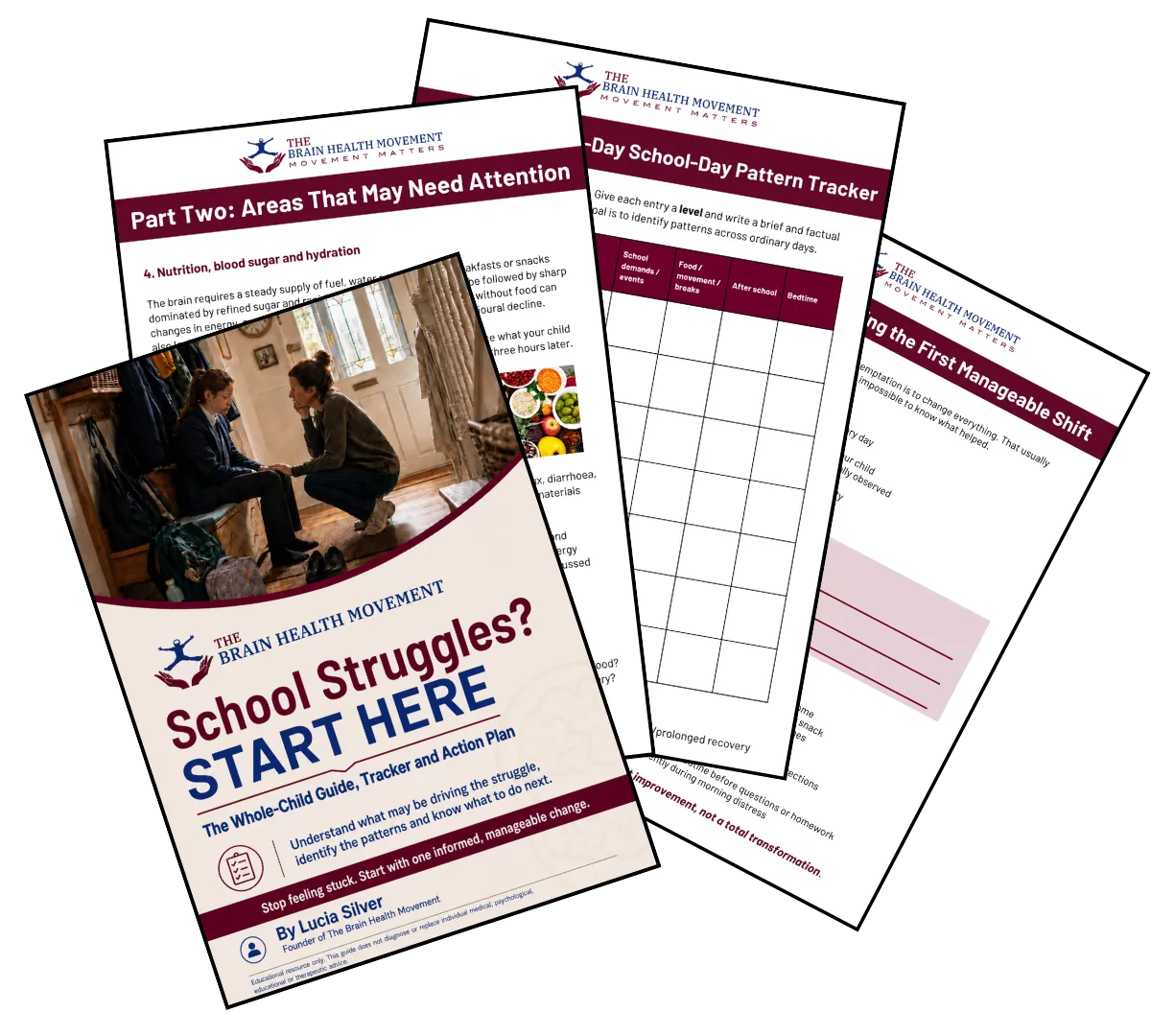
You will work through the process step by step...
1.
UNDERSTAND THE STRUGGLE
Learn why school can place enormous demands on a developing nervous system and why avoidance, shutdown, anxiety, inattention, physical symptoms and post-school collapse may all be signs that demand is exceeding capacity.
2.
COMPLETE THE WHOLE CHILD SCHOOL STRUGGLES SNAPSHOT
Use a structured checklist to identify symptom clusters, connections and areas across your child’s development, health, regulation and school experience that may deserve closer attention.
3.
EXPLORE WHAT MAY NEED ATTENTION
Understand why areas such as the nervous system, cellular energy, sleep, nutrition, digestion, immune load, movement, primitive reflexes, sensory processing, functional vision, environment and family regulation may affect your child’s ability to cope, learn and recover.
4.
TRACK SEVEN REAL SCHOOL DAYS
Record what happens from waking to bedtime across seven school days, including your child’s symptoms, demands, difficult moments, recovery and what genuinely helps.
5.
RECOGNISE THE PATTERNS
Use guided prompts to identify repeated triggers, difficult times, hidden demands, post-school collapse and the people, adjustments or support that help your child cope and recover.
6.
CHOOSE ONE MANAGEABLE FIRST SHIFT
Instead of trying ten new things at once, choose one informed change and create a simple 30-day plan to track your child’s capacity, recovery and resilience.

For the first time, I understood that different symptoms were part of one picture. I had more confidence, clearer questions to ask and no longer felt that I had to fix everything at once.
Amanda S.

Your £9.99 digital toolkit includes:
✅ The Whole Child School Struggles Snapshot Checklist
✅ Symptom cluster and pattern-recognition pages
✅ Whole child education across ten important areas
✅ A printable Seven-Day School-Day Pattern Tracker
✅ A detailed daily observation page
✅ Guided prompts for recognising hidden patterns
✅ A First Manageable Shift planning tool
✅ A structured 30-Day Action Plan
✅ Day 0 and Day 30 comparison pages
ONE PAYMENT: £9.99
No membership. No ongoing subscription.
The biggest change was having a starting point.
I went into our school meeting with specific and measured observations to better support the school in understanding why my child was struggling.
Danielle R.

Stop guessing.
Start gathering the clues.
School Struggles? Start Here!
The Whole Child Guide, Tracker and Action Plan
Your child’s school struggles are not random or separate. And they are not choosing to be difficult.
Start understanding what is happening beneath the behaviour.
Why I created School Struggles? Start Here!
From Lucia Silver, Founder of The Brain Health Movement.
I created this because I have been the parent watching a child struggle at school and not knowing where to begin.
The tears at the school gate. The meetings that went nowhere. The advice that contradicted itself. I know how lonely and exhausting that place can be, and how hard it is to keep showing up for your child when you do not know what to try next.
School Struggles? Start Here! brings together the tools I wish I had had at that point: A clear Whole Child Guide, a simple 7-day tracker to help you spot patterns, a 30-day action plan, and practical extra resources to help you go deeper.
You do not need to understand or fix everything at once.
You need one informed, manageable place to start. This is it.

FAQs
Is this an ebook or a workbook?
It is both. The guide includes short, accessible educational sections alongside printable checklists, observation pages, trackers and a structured 30-day action plan.
It has been designed to be used, not simply read.
Is this guide only for children who refuse school?
No. It is for families experiencing a wide range of school-related struggles, including anxiety, morning distress, poor concentration, sensory overwhelm, reading or handwriting difficulties, exhaustion, masking, post-school collapse, school avoidance and school refusal.
Does my child need a diagnosis?
No. The guide can be used whether your child has a diagnosis, is awaiting assessment or has no diagnosis at all.
It is designed to help you understand what you are observing, not to give your child a label.
Will the Snapshot Checklist diagnose my child?
No. The Snapshot is not a diagnostic test and does not produce a score.
It helps you observe and measure your child's difficulties, identify areas that may deserve further observation and present with clarity, symptoms that require school or appropriate professional support.
Do I need to complete everything at once?
No. Work through the guide at a pace that feels manageable.
The central principle is to observe carefully and choose one informed first shift, rather than making many changes at the same time.
How long will it take?
You can read the introductory sections and complete the initial Snapshot in one or two sittings.
The pattern tracker is completed across seven school days, followed by a manageable 30-day action period.
Is this a treatment plan?
No. This is an educational resource and observation toolkit.
It does not diagnose, prescribe treatment or replace individual medical, psychological, educational or therapeutic advice.
How will I receive it?
You will receive immediate digital access after purchase. You can read it on your device or print the worksheets and trackers you wish to use.
What happens after the 30 days?
You will repeat key parts of the Snapshot and compare your child’s starting point with their current capacity, recovery and resilience.
The guide will then help you decide whether to continue the change, refine it, explore another area or seek additional school or professional support.